See the complete route index at https://docs.crusible.dev/llms.txt before following links.
# Set a sandbox environment
Set the environment variables and secrets every Sandbox starts with, for your organisation or for yourself.
A Sandbox is the isolated coding machine where agents run. Its shell environment comes from two
pages in Settings. Settings names both pages **Sandbox**.
- The organisation page, at `/organisation/workspace-environment`, sets values for every member.
Owners and administrators edit it. Members see it read-only.
- Your personal page, at “/me/environment”, sets values for your own Sandboxes.
A personal value replaces the organisation value with the same name.
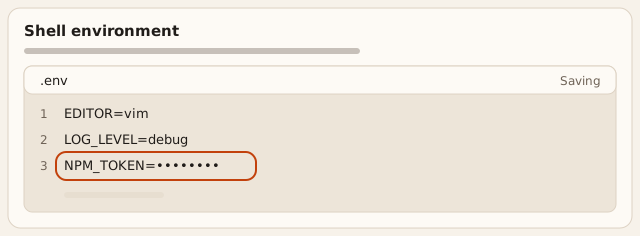
1. Open Settings. For your own values, open Sandbox under My settings.
For organisation values, open Sandbox under Account.
(Result: The page shows **Shell environment** with a `.env` editor.)
1. In the Environment file editor, add one NAME=value line per variable.
A name starts with a letter or an underscore and uses letters, digits and underscores.
Lines that start with # are comments.
(Result: Each line shows its line number in the gutter.)
1. Stop typing. Crusible saves the file one second after your last keystroke.
Crusible saves each new line as a secret and masks its value. Crusible never shows a saved secret value again.
To change a secret, replace the bullets with the new value. To remove a variable, delete its line.
(Result: The editor header shows **Saving**, then the line shows `NAME=••••••••`.)
1. Open a new terminal in your Sandbox and check the variable.
(Result: A new shell in your Sandbox has the variable.)
- **If this doesn't work:** When Crusible refuses a line, the editor lists it under the file as Line and its number, with the reason.
Fix that line and stop typing to save again.
If you see “The change was not saved. Try again.”, select Try again.
If you see “The entries did not load.”, select Try again.
Crusible reserves names that start with CRUSIBLE_, LD_ or GIT_CONFIG_, and names such as HOME, USER and SHELL. Choose another name.
If you can’t edit the organisation page, ask an owner or administrator to make the change.
A new Sandbox starts with the saved values.
A running Sandbox receives the change too. Terminals you open after the change see the new values.
A shell you opened earlier keeps the values it started with. A hibernated Sandbox receives the change when it wakes.
The personal page warns “Channel members can read values in their Sandbox.”
Settings masks a secret, and the shell still holds it as a variable.
Put a credential here only when everyone who works in that Sandbox may use it.
## Network policies and installed software
**Planned.**
The organisation page lists **Network policies** and **Installed software** with a **Coming soon** badge.
Neither row has controls, and neither saves a setting.
- [Terminal](https://docs.crusible.dev/reference/surfaces/terminal/) — Shells, machine selection, terminal tabs, file uploads and connection controls.- [Connect a compute provider](https://docs.crusible.dev/admin/connect-a-compute-provider/) — Check the availability of provider connections and find the machine controls.- [Settings](https://docs.crusible.dev/admin/settings/) — Personal preferences, organisation controls and the permissions that determine which pages you can open.